Profile and notifications
Your profile
Your name, contact details, unit number, photo and address. Some of these are what your community needs to reach you; some are what your neighbours see.
Your community may require specific fields as a checklist item, in which case the profile marks exactly those as required.
What neighbours see
Each shareable field is opt-in. What you make community-visible is what appears on your card in Neighbors and nowhere else. Nothing is shared by default, and nothing about your account, payments, violations or tickets is ever shared this way.
If you would rather not appear in the directory at all, share nothing.
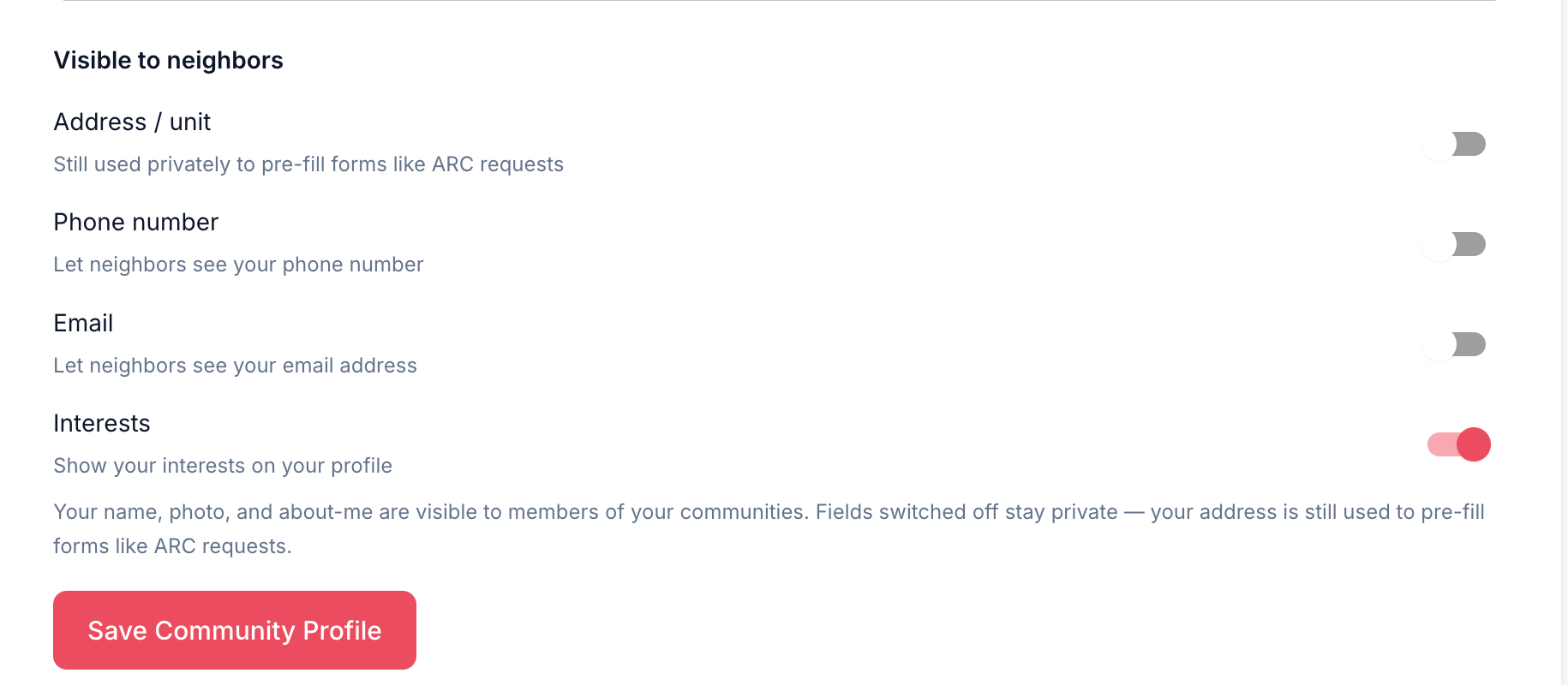 Every field is off until you turn it on. Your address stays in use privately to prefill forms.
Passkeys
Register a passkey from your profile to sign in with Face ID, Touch ID, Windows Hello or a hardware key. See accounts and signing in.
Notification preferences
Per category, controlling both email and push. Everything is on until you turn it off.
| Category | Fires when |
|---|---|
| Issue status updates | An issue you reported changes status |
| Issue comments | Someone comments on your issue |
| Announcements | A new community announcement is posted |
| Announcement comments | Someone comments on an announcement you follow |
| Community messages | An admin replies to you |
| Payment reminders | Something is due |
| Upcoming autopay | A subscription is about to charge itself |
| Fee published | A new fee applies to you |
| Violation notices | A violation is filed or escalated |
| Community board | Activity on the board |
| Booking cancelled | An admin cancelled a reservation of yours |
Preferences are per account and apply across the web app and the mobile apps.
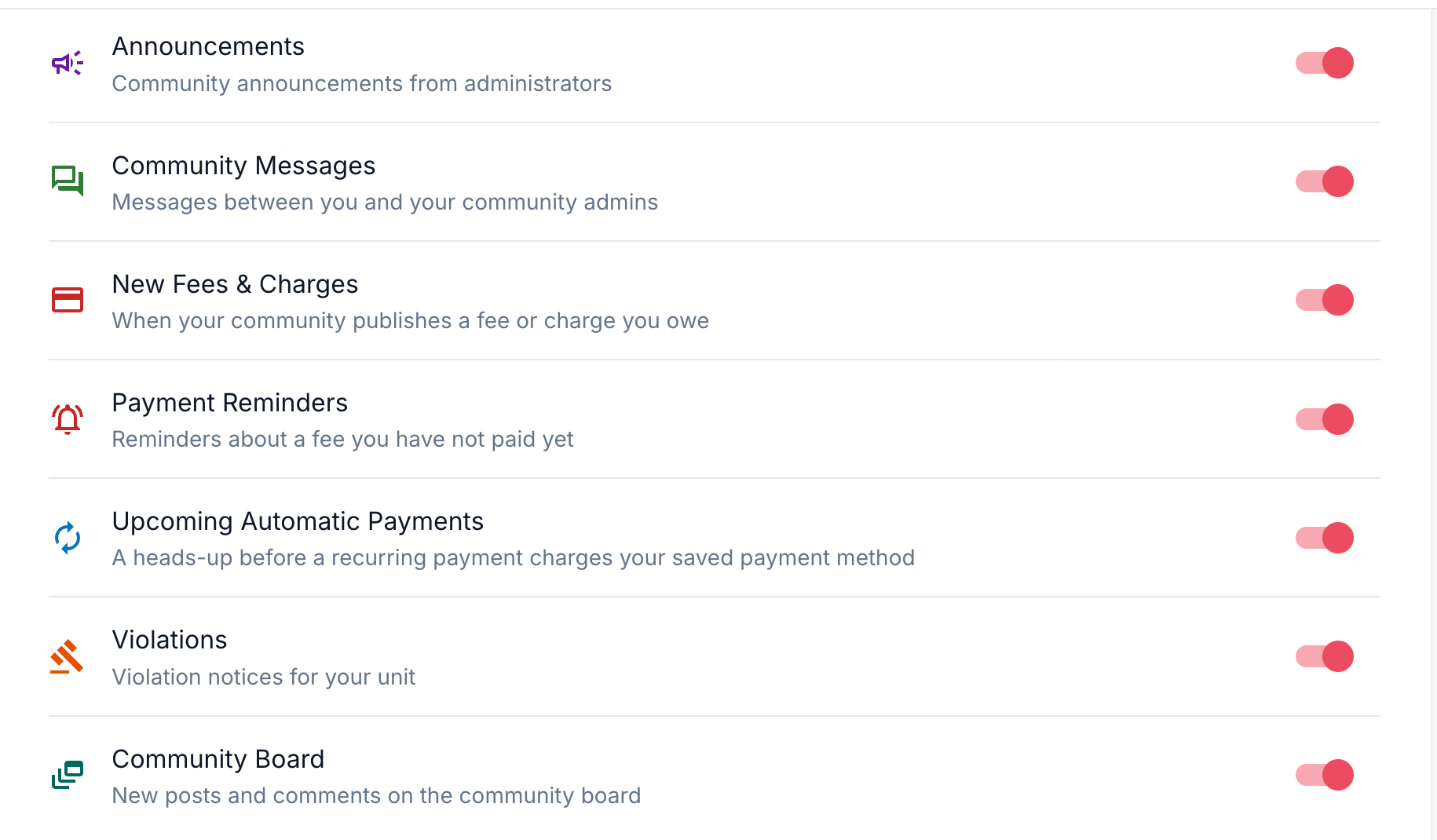 One toggle per category, covering both email and push.
In-app notifications
The bell in the header is a feed, and read state syncs across devices. Reading something on your phone marks it read on the web.
Deleting your account
From your profile. This removes your account and schedules your personal data for deletion. Records the community is obliged to keep, such as payment history and violation records, are retained as community records.